
The Problem Behind the Problem
A major aerospace MRO came to us with what seemed like a straightforward request: “improve the supply chain.”
But as is so often the case in complex repair operations—whether you’re maintaining aircraft, medical equipment, or industrial machinery—the stated problem wasn’t the real problem.
The hidden constraint: Every day a C-130 military transport aircraft sat in their hangar was wasted capital, diminished fleet readiness, and a deteriorating relationship with their Air Force customers. Their business model didn’t revolve around parts efficiency. It revolved around turnaround time.
Cut six days from the maintenance cycle and an Air Force effectively gained two additional aircraft without buying them. For the MRO: higher asset utilisation, delighted customers, and a sharper competitive edge against rival MROs.
This is the defining challenge of any repair organisation that doesn’t know what parts they’ll need before taking the covers off: you’re not managing inventory—you’re managing uncertainty against a ticking clock.
When the Best Solution Isn’t a Team—It’s the Right People
Industry: Aviation MRO (Maintenance, Repair & Operations)
Client: Major Aerospace MRO
Challenge: Aircraft turnaround time threatening fleet readiness for 12 Air Forces
Duration: 18 months (during COVID-19)
Result: 18% reduction in turnaround time, £8M excess stock cleared, £2M annual savings
The Power of the Coalition Model
Why Independent Associates Outperform Traditional Teams
This wasn’t a project won by a monolithic consulting firm deploying their “standard methodology.” It was won by a carefully assembled coalition of independent specialists, each bringing world-class expertise in their domain, united by a single shared objective.
Richard Aczel orchestrated the coalition—recognising that this problem needed more than one firm’s toolkit. What made this approach revolutionary:
- No organisational overhead draining the budget
- Zero internal politics between practice areas
- Best-in-class specialists in every discipline
- Aligned incentives around outcomes, not billable hours
- Adaptive structure—scale up expertise exactly when needed
This is how modern transformation works: dream teams don’t come pre-packaged; they assemble around the specific challenge.
Meet the Coalition: Each Expert’s Critical Contribution
Masood – The Strategist Who Reframed Everything
Former PwC Partner, now partner at Mindsheet Limited. Before a single spreadsheet was opened, Masood did something most consultants skip: he listened.
He interviewed every senior stakeholder who cared about the outcome. Not to validate assumptions—to destroy them. What he uncovered changed everything:
- The MRO was stocking mountains of the wrong parts
- High-consumption items were perpetually out of stock
- Unpredictable “black swan” parts could cripple entire maintenance cycles
- The real KPI wasn’t supply chain efficiency—it was turnaround time
Masood led the Pareto analysis that prioritised the main blockers, showing that 80% of delays came from 20% of parts categories. From that moment, everything snapped into place. The project had its North Star.
Dean – The Strategist Who Insisted on Magic
Dean brought commercial savvy and an eye for what transforms projects into legendary successes. “You can’t just sell Supply Chain 101,” he told the team. “Everyone wants a bit of magic.”
He was right. While segmentation could handle 80% of the parts, Dean pushed the coalition to tackle the riskiest, most unpredictable segment—the black swans—with genuine innovation. That’s what made this project not just successful, but remarkable.
Praful – The Visual Systems Thinker
Created the one-page business map that unified operations, supply chain, hangars, and planning into a single visual truth. In complex transformation projects, clarity is currency. Praful’s map became the Rosetta Stone that helped every stakeholder see how their decisions rippled through the system.
Toby – The Analytics Engineer
Did exceptional work on the segmentation, analytics, and signal processing—turning theoretical frameworks into actionable stocking policies. Toby’s work ensured that insights didn’t stay in PowerPoint; they became operational rules the business could execute daily.
Steve – The Supply Chain Architect
Brought deep discipline from decades in supply-chain operations. Every recommendation, every model output, every policy change had to pass Steve’s test: Is this predictable? Is it sustainable? Can the organisation actually do this? His rigor prevented the classic consulting failure: brilliant strategy that dies in implementation.
Roger – The Change Agent Who Made It Stick
The boots-on-the-ground operator who earned the trust of the technicians. Roger understood that transformation isn’t about processes—it’s about people believing the new way is better. He was the bridge between the analysts and the hangar floor, making the organisational change real and permanent.
Raglan – The AI Architect Who Tamed Black Swans
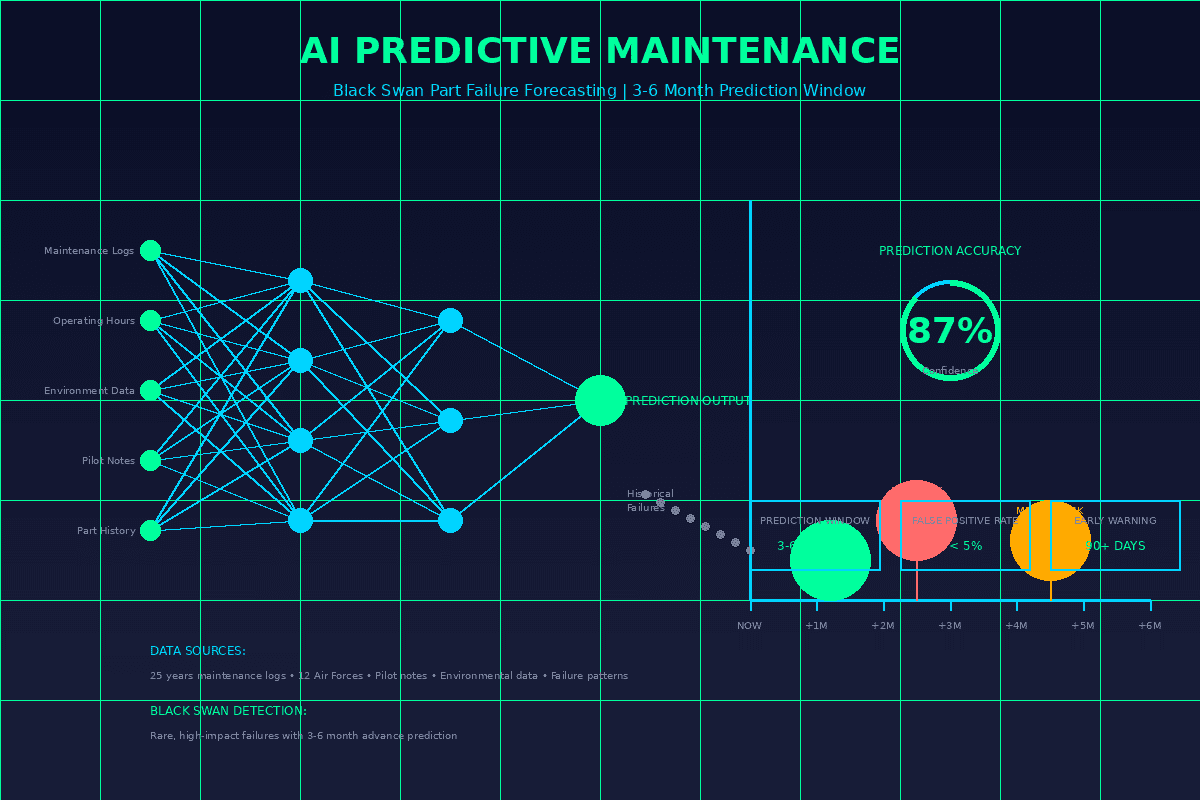
Co-founder of Mindsheet Limited, with pioneering AI credentials dating to 1988. While the backbone of the solution was classic supply-chain segmentation, Raglan built something the client had never seen: a deep learning model that could predict rare, high-value part failures.
Working through 25 years of maintenance logs, thousands of pilots’ notes, and data from 12 different Air Forces, the model picked up patterns no human could spot:
- Corrosion signatures on Swedish aircraft stored near salt lakes
- Gender-skewed crew patterns affecting toilet component wear
- Subtle ageing effects on particular airframes
- Environmental conditions interacting with specific part types
This is the future of MRO: not just reacting to failures, but reading the future position of the board. The model gave Marshall a 3-6 month predictive window for the riskiest parts—the ones that could derail an entire maintenance cycle.
The Results: When Strategy Meets Execution
| Metric | Before | After | Impact |
|---|---|---|---|
| Average turnaround time | 34 days | 28 days | 18% improvement |
| Excess stock value | £8M tied up | £0M | £8M working capital released |
| Annual parts savings | Baseline | £2M reduction | £2M annual savings |
| Emergency expediting costs | £100K per part | £6K planned procurement | 94% cost reduction on critical parts |
For the Air Forces: More aircraft available without buying new ones
For Marshall: Higher asset utilisation, delighted customers, competitive advantage
For the team: Proof that the coalition model works
The AI Breakthrough: Forecasting the Unforecastable
Why Black Swan Parts Matter in MRO
In any repair operation—aviation, medical devices, industrial equipment—there’s a category of parts that defies traditional inventory management:
- Rare failures with catastrophic impact
- Expensive components you can’t afford to stock “just in case”
- Long lead times that can’t be rushed
- Unpredictable patterns that confound standard reorder algorithms
These are your black swans: events that seem random but have profound consequences.
Traditional supply chain systems treat these as exceptions. They react after failure. Marshall wanted something better.
How Deep Learning Changed the Game
Raglan’s model didn’t try to predict exact failures—that’s impossible. Instead, it identified risk windows: 3-6 month periods when specific aircraft, specific parts, and specific operating conditions created elevated failure probability.
The training data:
- 25 years of maintenance logs
- Pilots’ pre-flight and post-flight notes
- Environmental data (humidity, temperature, salt exposure)
- Operating hours, cycles, mission profiles
- Historical failure patterns across 12 Air Forces
The insights:
- Swedish C-130s near salt lakes showed premature corrosion in specific assemblies
- Certain crew gender ratios correlated with toilet system wear patterns
- Temperature cycling in Mediterranean operations affected hydraulic seal longevity
- Specific airframe serial numbers had latent manufacturing variations affecting wear
The outcome: The MRO could now pre-position high-value parts before failures cascaded. Instead of £100K emergency procurements derailing maintenance schedules, they made £6K planned purchases with comfortable lead times.
Why This Matters Beyond Aviation
This model works for any MRO operation that faces:
- Unpredictable component failures
- High-value parts with long lead times
- Complex operating environments
- Large installed base with historical data
Application examples:
- Medical equipment repair: Predicting MRI magnet quench events, CT tube failures
- Industrial machinery: Forecasting bearing failures in wind turbines, hydraulic pump degradation
- Marine MRO: Anticipating propulsion system failures, corrosion patterns
- Rail maintenance: Predicting bogie component wear, signaling system failures
The technology is no longer experimental—it’s proven in one of the most demanding environments imaginable: military aviation during a pandemic.
Lessons: Why Coalitions Beat Traditional Consulting
1. Expertise Without Overhead
Traditional consulting firms carry massive infrastructure costs. Office buildings. Internal systems. Partner compensation. Middle management. The client pays for all of it through inflated day rates.
The coalition model: You pay for expertise, not infrastructure. Each specialist operates lean, passing savings directly to the client while maintaining top-tier quality.
2. No Artificial Boundaries
In traditional firms, strategy consultants don’t implement. Supply chain specialists don’t do AI. Change management is a different practice area. The project gets fragmented across internal silos.
The coalition model: Every expert brings their full toolkit. Masood can discuss strategy and execution. Raglan can build models and explain business value. The work stays integrated because there are no artificial walls.
3. Aligned Incentives
Big firms optimize for follow-on work, recurring revenue, expanding scope. Success is measured by project extension, not project completion.
The coalition model: Independent specialists optimize for reputation and referrals. They win when the project succeeds spectacularly, not when it drags on profitably. Their incentive is your result.
4. Adaptive Scaling
The client needed world-class AI during model development, deep supply chain expertise during segmentation, change management capability during implementation. Traditional firms either:
- Deploy junior staff from their bench (wasting your money)
- Keep senior experts billable the entire engagement (wasting your money)
The coalition model: Experts scale in and out based on need. You get senior expertise exactly when it matters, and you don’t pay for it when it doesn’t.
5. Speed to Excellence
No waiting for internal resource allocation. No navigating partner politics. No “getting up to speed” on the firm’s methodology.
The coalition model: The right people, with the right skills, focused on your problem, from day one.
The Universal Pattern: From Firefighting to Foresight
Whether you’re maintaining aircraft, repairing medical equipment, servicing industrial machinery, or managing any complex repair operation, the pattern is always the same:
- Find the real constraint (usually not what they tell you initially)
- Segment demand by predictability and impact (80/20 rule applies)
- Apply AI to the unpredictable high-impact segment (your black swans)
- Design policies around the constraint, not around legacy categories
- Change management from the ground up (technicians must believe it works)
The MRO didn’t just fix their supply chain. They learned how to read the future by understanding demand.
What This Means for Your Organisation
Is This You?
- Repair operations where you don’t know what parts you need until you take the covers off
- Unpredictable failures of high-value components creating schedule chaos
- Long lead times that turn minor failures into business crises
- Competing priorities between stock costs and service level
- Legacy systems that react instead of predict
What You Can Expect
When you work with a coalition like ours, you’re not buying methodology. You’re buying mastery.
- Masood Hassan brings 25+ years transforming enterprises
- Raglan Tribe brings pioneering AI experience since 1988 and practical business transformation expertise
- Proven models that work in the real world, not just simulations
- Adaptive structure that scales expertise to your specific challenge
We find the dominant constraint. We build the predictive model. We help your team deliver results that feel almost unfair.
Ready to Transform Your MRO Operations?
The question isn’t whether AI can forecast your black swan parts. (It can.)
The question is: How much value are you leaving on the table by reacting instead of predicting?
- How many days could you cut from your turnaround times?
- How much working capital is trapped in the wrong inventory?
- How much are emergency procurements costing vs. planned purchases?
- How much competitive advantage are you conceding to faster competitors?
Let’s find out.
Contact Mindsheet Limited for a short diagnostic consultation. We’ll identify your dominant constraint, estimate the value at stake, and show you what a coalition of independent experts can achieve.
About Mindsheet Limited
Mindsheet Limited is a business transformation consultancy specialising in AI-enabled operational excellence. Co-founded by Raglan Tribe (AI pioneer since 1988), we serve enterprise clients including Toyota, Siemens, IBM, Microsoft, Ford, and the UK Ministry of Defence.
Our model: Assemble the best independent specialists for your specific challenge. No overhead. No politics. No artificial boundaries. Just world-class expertise focused on your results.
We find the constraint. We build the model. We transform the business.
Get in touch: https://www.mindsheet.com/contact-us
This case study was delivered during COVID-19, proving that even in the most challenging circumstances, the right coalition of experts can transform complex operations. The model continues to operate at this aerospace MRO, and the approach has been replicated across other MRO operations worldwide.