When the world went quiet during the Covid lockdowns, one project kept me sane — working with the energetic, fast-growing team at Silverstream Technologies, pioneers of air lubrication systems for ships.
Background
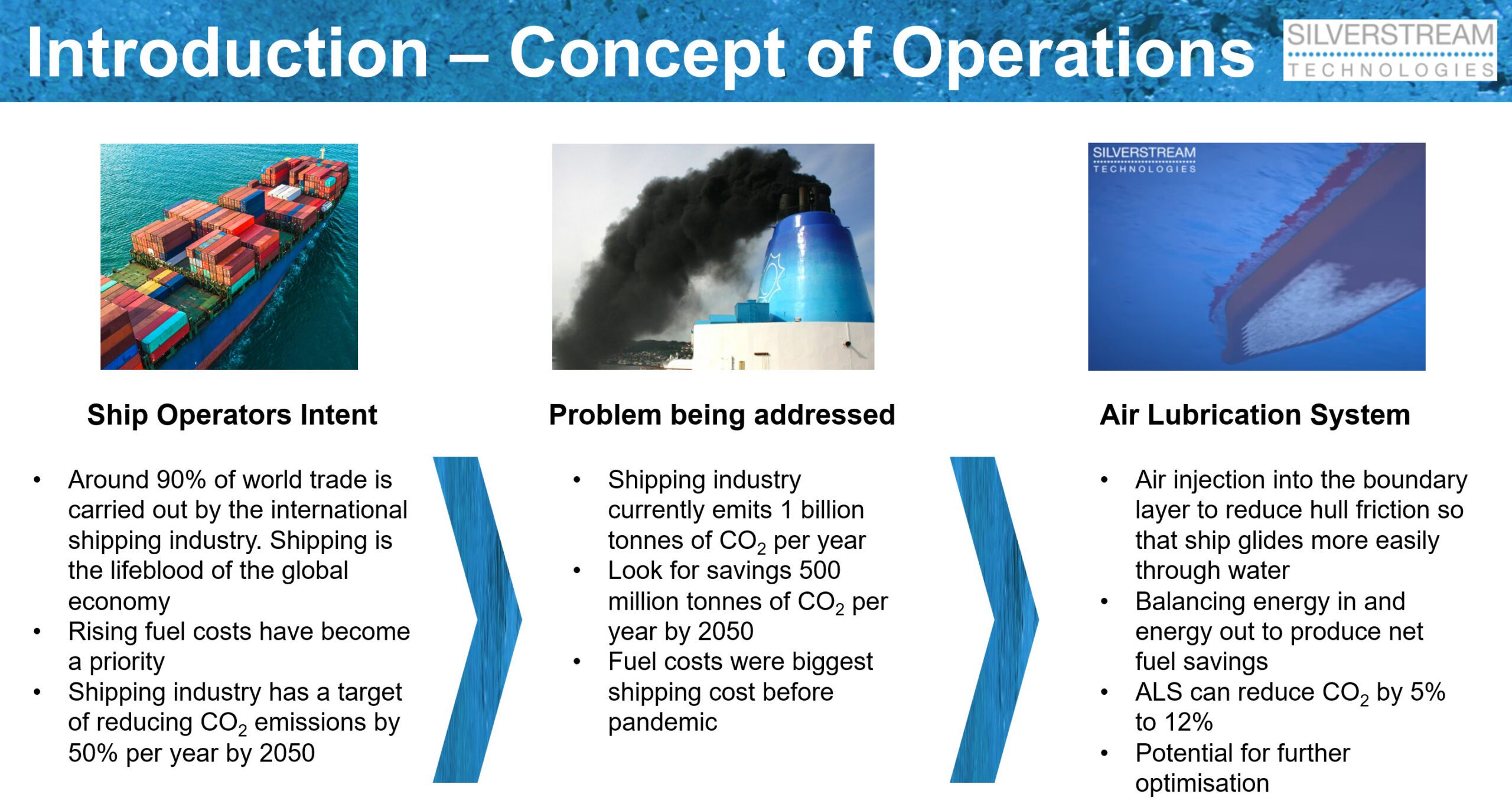
Silverstream’s innovation is elegant: by releasing a controlled layer of air bubbles beneath a ship’s hull, friction between the hull and water is reduced, cutting fuel consumption by around 10%. In an industry responsible for about 1 billion tonnes of CO₂ emissions a year, that’s not just a saving — it’s a revolution.
But while the technology was proven, scaling it safely across vessels required a step change in systems engineering discipline. My role was to help their talented engineers grow into true systems thinkers, capable of building resilient designs and creating credible safety cases.
The Challenge
The Silverstream team were already adept at Failure Mode and Effects Analysis (FMEA) — but they needed to go deeper. Together, we explored the next layer of assurance: Fault Tree Analysis (FTA) and structured system specifications.
We began with a deceptively simple question:
“What’s the worst thing this system could do to a ship?”
The answer, of course — sink it.
From there, we worked backwards through every conceivable path that could lead to that outcome: flooding, fire, oil pollution, electrocution, or loss of control. Each branch of the fault tree revealed where design resilience mattered most, and where over-engineering added cost without benefit. This “top-down thinking” helped the team right-size their designs — robust where safety demanded it, lean where it didn’t.
The Approach
We introduced a systematic process:
- Mapping Level 1 and Level 2 system requirements for the Control and Monitoring System (CMS).
- Building traceability between operational objectives, safety functions, and acceptance criteria.
- Developing standardised documentation and checklists to support the rapid roll-out of systems across fleets like Grimaldi.
- Embedding the Fault Tree Analysis into Silverstream’s standard engineering practice — not just as a compliance exercise, but as a way of thinking.
The Impact
The result was a stronger, more confident engineering culture — one that could communicate with shipyards, integrators, and owners using a shared language of safety and systems thinking. The project also accelerated Silverstream’s move toward a standardised generation-1 platform, paving the way for future performance upgrades.
For me personally, this was a ray of light in an otherwise grey period of lockdowns and remote work. Collaborating with such a young, committed, and creative team reminded me why I love engineering — the fusion of rigour, imagination, and purpose. Silverstream’s technology doesn’t just make ships more efficient; it helps make the world a little cleaner.
Key Achievements:
- Introduced Fault Tree Analysis and System Specification discipline to complement existing FMEA practice.
- Strengthened system safety assurance through structured reasoning from top-level hazards.
- Created a framework for standardised CMS requirements across multiple vessels.
- Enabled a 10% reduction in fuel consumption without compromising safety or increasing power costs.
- Mentored a growing engineering team during a critical phase of expansion and innovation.