
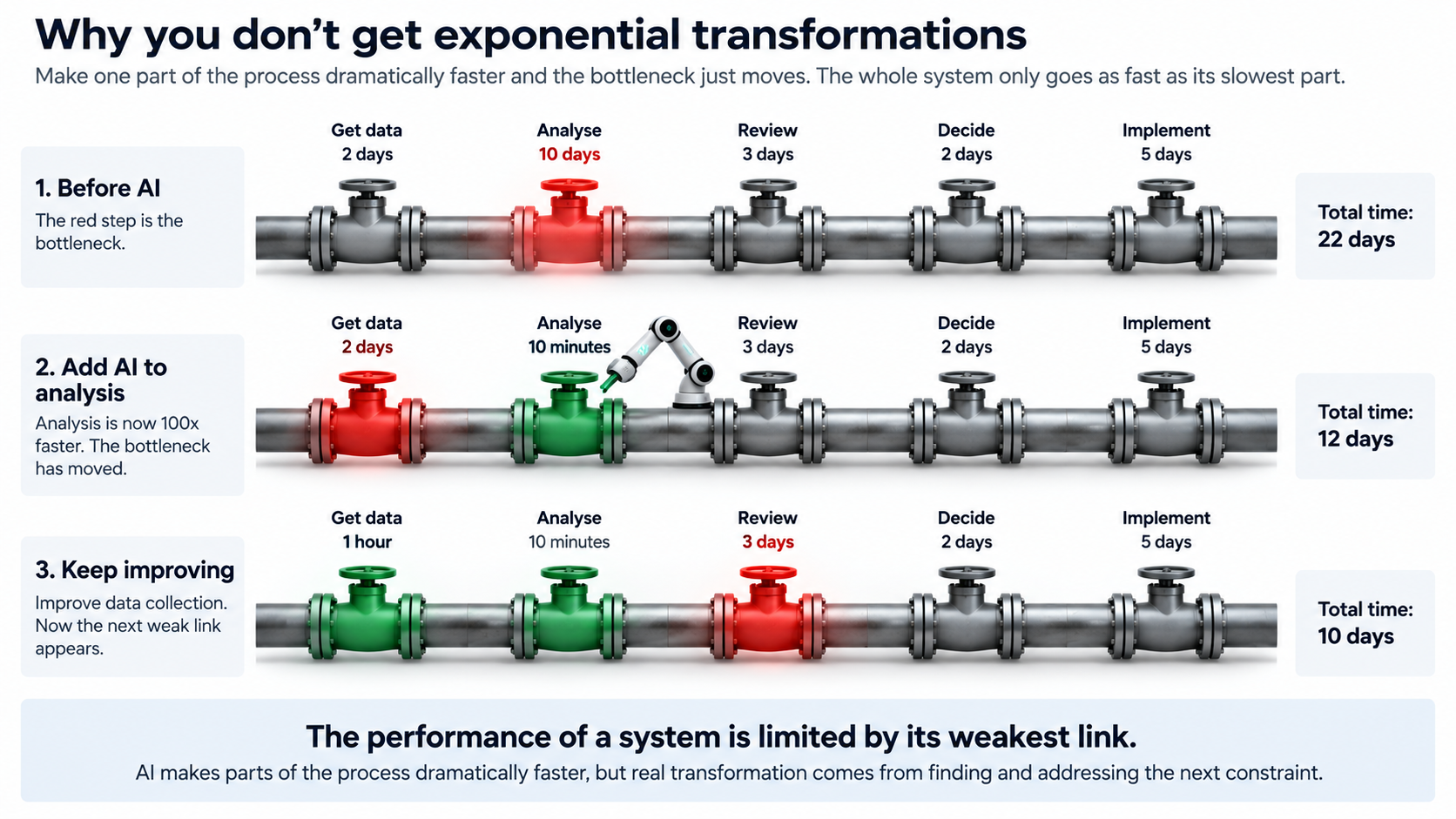
Imagine a piece of analysis that used to take ten days.
Gather the data.
Load it into spreadsheets.
Clean it.
Analyse it.
Test different hypotheses.
Build some charts.
Write the conclusions.
Ten days.
Then AI arrives.
The analysis that took ten days can now be done in ten minutes.
That’s extraordinary.
So the whole process should be hundreds of times faster.
Except it isn’t.
Because it still takes two days to get the data.
And suddenly those two days matter enormously.
AI didn’t eliminate the bottleneck.
It moved it.
We’ve seen this before
This is what happens whenever a genuinely transformative technology arrives.
Imagine a factory where one machine can produce 100 components an hour and another can produce 10.
Replace the slow machine with one capable of producing 1,000 an hour.
Have you made the factory ten times faster?
Probably not.
You’ve simply discovered which machine is now the slowest.
Improve that one and another constraint appears.
Systems don’t become infinitely productive because one component becomes infinitely productive.
The constraint moves.
And that’s exactly what’s beginning to happen with AI.
Analysis used to be scarce
For much of my career, good analysis was expensive.
You needed experienced people.
You needed analysts.
You needed spreadsheets, databases and specialist tools.
You needed people who understood statistics, markets, engineering, operations or finance.
And you needed time.
A consulting team could spend weeks analysing a problem before producing an answer.
That made analysis valuable because analysis was scarce.
AI is changing that astonishingly quickly.
I can now take a substantial dataset and explore questions in hours that would once have required a team for weeks.
I can test hypotheses.
Interrogate markets.
Compare scenarios.
Analyse interviews.
Look for patterns.
Build models.
Challenge assumptions.
Iterate.
Then iterate again.
The amount of analytical work one person can perform has changed dramatically.
But something unexpected happens when analysis becomes abundant.
Everything feeding the analysis becomes more important.
Try getting the data
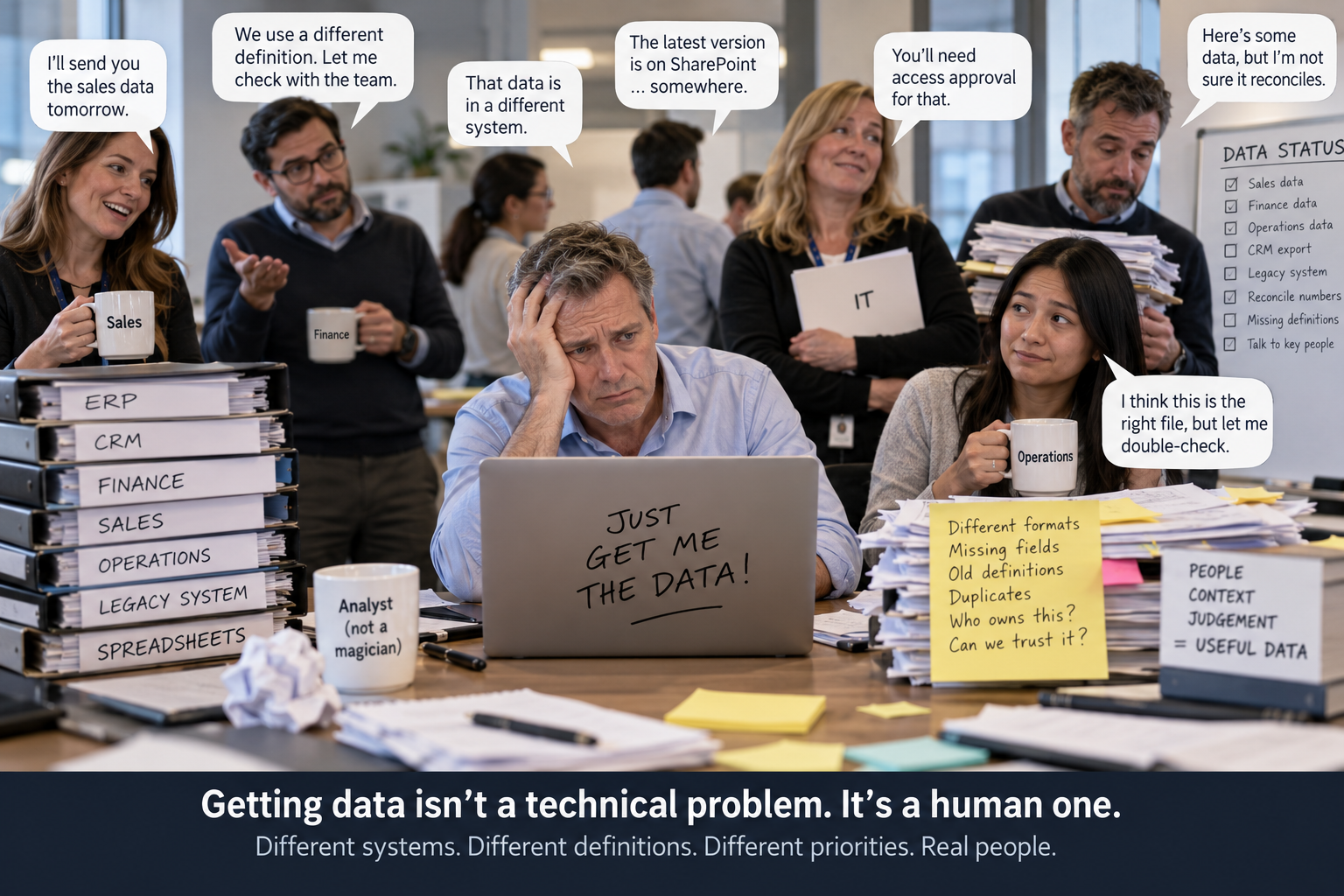
Anyone who has worked inside a real company will recognise this conversation.
“Can I have the sales data?”
“Yes.”
A week later:
“Can I have the sales data?”
“Oh, I thought Finance had sent it.”
Finance sends something.
It doesn’t reconcile with the management accounts.
Sales has another version.
The CRM says something different again.
One acquired company uses a different product hierarchy.
Half the historical records use old customer names.
Somebody changed the definition of an order two years ago.
There are 14 spreadsheets containing slightly different forecasts.
And the one person who actually understands why the numbers don’t reconcile is on holiday.
Welcome to enterprise data.
There is no magical lake of truth
We often talk about corporate data as though it is sitting in a vast pristine reservoir waiting for AI to drink from it.
It isn’t.
It’s more like an archaeological site.
Layers have been added over years.
ERP systems.
CRM systems.
Finance systems.
Acquisitions.
Spreadsheets.
Local databases.
Power BI.
Management reports.
Legacy systems nobody quite dares switch off.
And then there is perhaps the most important database in the organisation:
what people know.
Why was that customer classified differently?
Why did demand spike?
Why did the factory stop ordering that component?
Why does the official process say one thing while everyone actually does something else?
Those answers may exist nowhere except inside somebody’s head.
We learned this the hard way
On one recent assignment, we eventually assembled a remarkably rich picture of the business.
We had ERP information.
Salesforce data.
Information from several businesses acquired at different times.
Management accounts.
Market information.
And hundreds of pages of management interviews.
We progressively cleaned it, structured it and reconciled it until we had a dataset we trusted.
One of our checks was brutally simple:
Does this representation of the business reconcile back to the money?
If the analytical model says the company sold £100 million and the accounts say £120 million, something is wrong.
Keep going until you understand why.
Eventually we reached the point where we could interrogate the business from almost any direction.
Customer.
Product.
Market.
Channel.
Geography.
Salesperson.
Business unit.
Time.
And once that foundation existed, something remarkable happened.
New analysis became incredibly fast.
Questions that might once have taken weeks could sometimes be explored in a day.
AI was doing exactly what everybody says AI can do.
But there was a catch.
Building the analytical capability wasn’t the hardest part
Getting access to the information was.
It took time to understand:
Who owns the data?
Who understands it?
Which version is trustworthy?
What does this field actually mean?
Which numbers reconcile?
Which interviews do we need?
Who sees which part of the system?
And perhaps most importantly:
Who trusts us enough to give us the information?
That last question doesn’t appear in many AI architecture diagrams.
But it matters enormously.
You don’t walk into an organisation on Monday morning and ask someone to send you the entire ERP database because your AI would like to analyse it.
Trust has to exist.
Context has to exist.
People need to understand what you’re trying to achieve.
And somebody has to know what information is actually useful.
AI can analyse the wrong thing brilliantly
This is the danger.
Give AI a large amount of poorly structured information and it can produce an extraordinarily convincing answer.
That doesn’t make the answer right.
If two datasets have been joined incorrectly, the analysis may be wrong.
If the organisation changed its definitions halfway through the period, the trend may be meaningless.
If the question itself is badly framed, AI can answer the wrong question at breathtaking speed.
That’s why the analyst hasn’t disappeared.
The role is changing.
The valuable skill is increasingly not:
Can you calculate this?
It’s:
What should we calculate?
What evidence would prove or disprove this hypothesis?
Can we trust this data?
What are we missing?
Does the answer make sense?
That’s judgement.
And data isn’t the only new bottleneck
Suppose we solve the data problem.
AI analyses everything beautifully.
We identify the constraint.
Now what?
The Sales Director disagrees.
Operations thinks the intervention threatens their targets.
Finance won’t release the investment.
Engineering thinks the diagnosis is simplistic.
The CEO doesn’t want another fight with the board.
The constraint has moved again.
Now the scarce resource is alignment.
Solve that and perhaps the constraint becomes implementation capacity.
Solve that and perhaps it becomes skills.
Solve that and perhaps it becomes customer adoption.
That’s how systems behave.
There is always another Herbie.
This is why AI won’t make management disappear
AI is extraordinarily good at making certain previously scarce capabilities abundant.
Analysis is one of them.
But organisations aren’t analytical models.
They are systems containing:
People.
Assets.
Processes.
Information.
Incentives.
Relationships.
Customers.
Suppliers.
Competitors.
Politics.
And time.
Making one component dramatically more capable changes the system.
It doesn’t abolish the system.
This changes the economics of consulting
And this is where things become really interesting.
If analysis becomes dramatically faster and cheaper, we shouldn’t use AI merely to produce more analysis.
We should use it to produce better diagnosis.
Traditional consulting economics often meant that analysing a business deeply was expensive.
Large teams.
Weeks of interviews.
Weeks of analysis.
More weeks producing the report.
AI allows us to put far more analytical horsepower behind a relatively small diagnostic engagement.
At Mindsheet, that’s exactly what we’re doing with Precision Diagnostics.
The client still deals with experienced humans.
We interview the management team.
We gather the relevant documents and data.
But behind that human interface, we use technology aggressively to process evidence, compare perspectives, test causal relationships and build a coherent representation of the business as a system.
The objective isn’t a bigger report.
It’s a more precise answer.
What’s the point?
AI will make many things dramatically faster.
But don’t confuse improving one component with improving the whole system.
When something that used to be scarce becomes abundant, the economic value moves somewhere else.
Analysis becomes abundant.
Reliable evidence becomes scarce.
Then judgement.
Then alignment.
Then execution.
The constraint moves.
And the organisations that benefit most from AI won’t simply be those that use it everywhere.
They’ll be the ones that repeatedly ask:
What has become the constraint now?
At Mindsheet, our Precision Diagnostic is designed to answer exactly that question.
We combine structured management interviews, business data, documentary evidence, systems thinking and AI-assisted analysis to identify what’s actually constraining performance and narrow the intervention required.
Typically, we can complete the diagnostic in around two weeks, with minimal demand on individual members of the management team.
If you’d like Mindsheet to perform a Precision Diagnostic on your business, please contact us.
AI doesn’t remove the bottleneck. It reveals the next one.