
In Eli Goldratt’s The Goal, there’s a wonderfully simple moment when the problem becomes obvious.
A group of Scouts is hiking through the countryside and the line keeps stretching out.
Eventually they identify Herbie.
Herbie is the slowest Scout.
Once you know that, everything becomes easier. Stop trying to make the fastest Scouts faster. Help Herbie and the whole troop moves faster.
It’s a brilliant explanation of a system constraint.
There’s just one problem.
Real business constraints rarely walk around wearing a badge saying “Herbie”.
If they did, your management team would have fixed them already.
The problems that survive are usually the ones where cause and effect have become difficult to see.
And that distinction matters.
Some problems are simple
Imagine a production machine stops.
The operator looks at the control panel.
A sensor has failed.
Replace the sensor.
Restart the machine.
Cause and effect are obvious.
Businesses deal with thousands of problems like this every day without consultants, transformation programmes or sophisticated diagnostics.
Good management teams are perfectly capable of fixing them.
The interesting problems start when the answer isn’t obvious.
Some problems are complicated

An aircraft keeps developing an intermittent fault.
Is it the sensor?
The wiring?
Software?
Connector?
Power supply?
Temperature?
Vibration?
There is an answer.
But finding it requires expertise, data and analysis.
That’s a complicated problem.
Engineers are very comfortable with these.
Break the system down.
Measure it.
Analyse it.
Find the fault.
Fix it.
Unfortunately, organisations contain something that aircraft don’t.
People.
And that takes us into a different world.
Then problems become complex
Sales are falling.
Why?
Ask the Sales Director.
“The product isn’t competitive.”
Ask Engineering.
“The product is fine. Sales keeps promising things we never designed.”
Ask Operations.
“We could deliver perfectly well if Sales stopped changing the forecast.”
Ask Sales.
“We change the forecast because Operations can’t deliver.”
Ask Finance.
“Margins are disappearing because everyone keeps expediting everything.”
Who is right?
Possibly all of them.
That’s a complex system.
Cause and effect are no longer sitting conveniently next to one another.
The symptom might appear in Sales while the cause sits in Engineering.
A decision made in January might create a problem in June.
Improving one department might make another department worse.
People respond to incentives.
Customers respond to the company.
Competitors respond to customers.
People create workarounds to compensate for other people’s workarounds.
And eventually nobody can quite remember why the system works the way it does.
Now try finding Herbie.
Sometimes the problem lives between the boxes
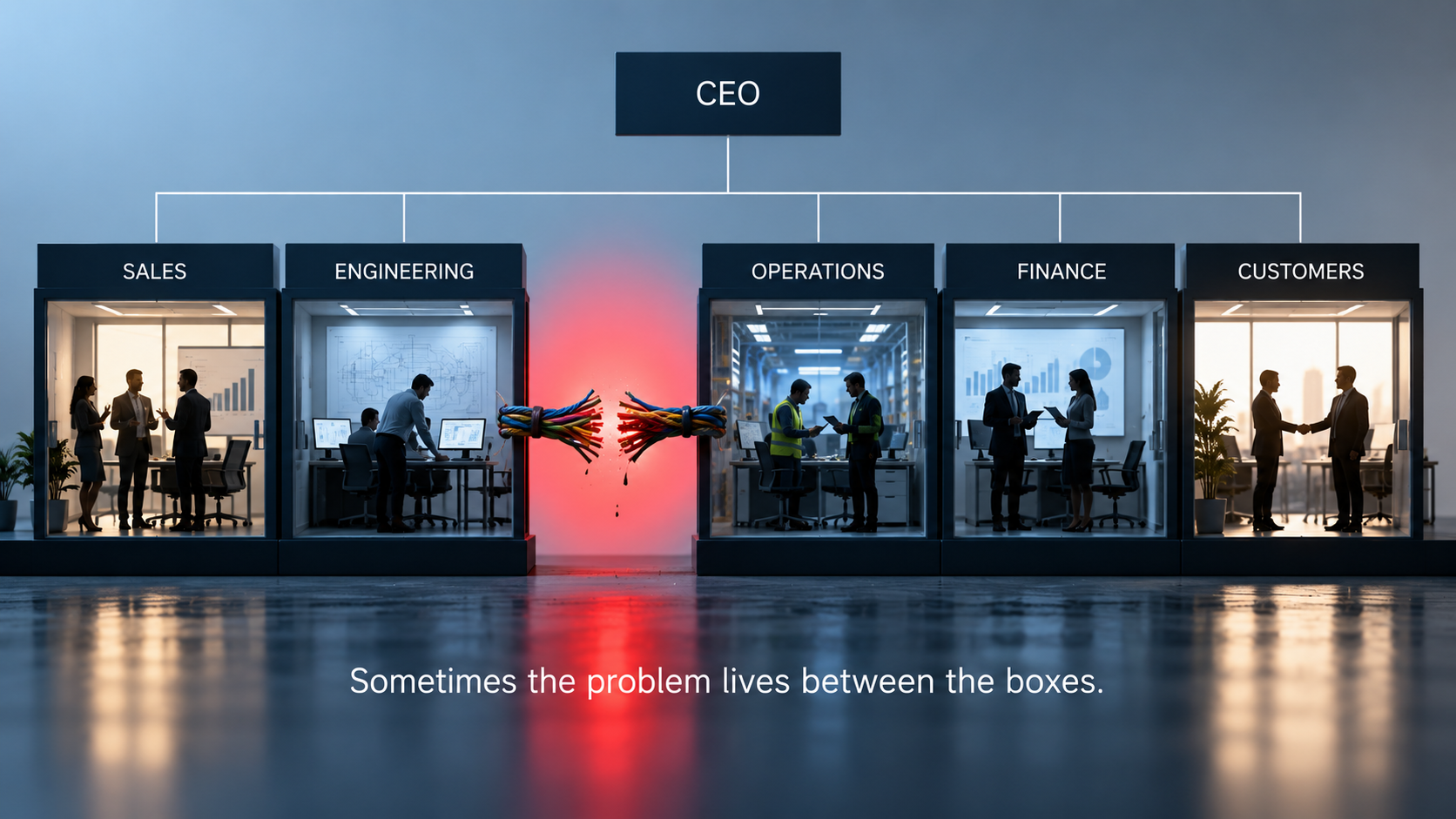
Organisation charts encourage us to think that businesses consist of departments.
Sales.
Engineering.
Operations.
Finance.
Supply Chain.
But businesses don’t create value inside boxes.
They create value through the connections between them.
Engineering can be excellent.
Manufacturing can be excellent.
And the interface between Engineering and Manufacturing can still be dreadful.
Perhaps specifications arrive too late.
Perhaps Manufacturing isn’t involved early enough.
Perhaps Engineering doesn’t receive useful feedback.
Perhaps the two functions are measured against conflicting objectives.
Neither department is necessarily the problem.
The relationship between them is.
And relationships don’t appear on the organisation chart.
We saw this with a leadership team
Mindsheet worked with the leadership team of a major joint venture.
On the surface, there appeared to be significant disagreement about strategy.
Some leaders wanted greater focus.
Others appeared to want diversification.
Some seemed cautious.
Others appeared aggressive.
Exactly the sort of situation that can trigger months of workshops, politics and attempts to “align the leadership team”.
So we interviewed the key stakeholders and mapped their positions.
And something interesting happened.
A significant part of the disagreement disappeared.
They weren’t necessarily advocating incompatible strategies.
They were talking about different points in time.
One executive was describing what the business needed to do now.
Another was describing where it needed to be several years later.
Without making those assumptions explicit, their positions sounded contradictory.
Once we mapped the perspectives properly, much of the apparent strategic conflict could be reconciled.
That’s an important diagnostic result.
Because sometimes the correct intervention isn’t:
Fix the disagreement.
It’s:
Show people that they’re not actually disagreeing about what they think they’re disagreeing about.
That’s a much smaller intervention.
And sometimes the system is chaotic
There is another category entirely.
The factory has stopped.
Cash is running out.
A critical programme has collapsed.
A cyberattack is under way.
Customers are leaving faster than management can understand why.
In those situations, detailed diagnosis can actually be dangerous.
Imagine walking into a bathroom where water is pouring through the ceiling.
You don’t start analysing whether the bathroom layout could be improved.
You don’t commission a study of plumbing efficiency.
You don’t interview the family about their future bathroom requirements.
You turn off the bloody tap.
Stabilise first.
Diagnose second.
Improve third.
So there are really different kinds of management problem
Some are simple.
Management can see the cause and fix it.
Some are complicated.
The answer can be discovered through expertise and analysis.
Some are complex.
Cause and effect are tangled through people, processes, incentives, feedback loops and time.
And some are chaotic.
You have to stabilise the system before meaningful diagnosis is even possible.
The mistake is treating them all the same way.
A complicated problem can often be analysed.
A complex problem has to be reconstructed.
That’s what Precision Diagnostics does differently
At Mindsheet, we don’t start by assuming we know where the problem is.
We build a 360-degree picture of the system.
We interview the key people who see different parts of it.
We gather the available operational and financial data.
We look at ERP and CRM information where relevant.
We review reports, plans, procedures and existing analysis.
Then, behind the scenes, we use systems thinking and technology to connect those different perspectives.
We establish what the system is actually trying to achieve.
We map the symptoms.
We look for the causal relationships between them.
We identify where different stakeholders see the system differently.
And we progressively narrow the possibilities until the underlying constraint becomes visible.
Because disagreement isn’t simply an inconvenience in the diagnostic process.
It’s data.
If Sales, Engineering and Operations all tell us different stories, we want to understand what kind of system could make all three stories appear true.
That’s often where the interesting answer lies.
What’s the point?
Goldratt was right.
Improving the constraint can improve the performance of the whole system.
But identifying the constraint in a real organisation is considerably harder than spotting the slowest Scout.
If the problem were obvious, somebody would probably already have fixed it.
The valuable problems are the ones hidden inside the interactions between people, processes, information and decisions.
And that’s why diagnosis matters.
Before you fix the problem, make sure you’ve found the problem.
If your business is underperforming, but your leadership team has different views about what’s causing it, Mindsheet’s Precision Diagnostic is designed to create a clear, evidence-backed picture of the system and pinpoint what’s actually holding it back.
Typically, we can complete the diagnostic in around two weeks, with minimal demand on individual members of your management team.
If you’d like Mindsheet to perform a Precision Diagnostic on your business, please contact us.