
Imagine taking your car into a garage because the engine keeps cutting out.
The mechanic has a quick look and says:
“I think we should replace the engine.”
You’d probably ask a few questions.
So he runs some diagnostics.
“Good news. We don’t need to replace the engine.”
Excellent.
“But I think we should replace the entire fuel system.”
Better.
Then another mechanic arrives with better diagnostic equipment.
He connects it to the car, runs some tests and says:
“It’s this sensor.”
£80.
Twenty minutes.
Fixed.
Which mechanic demonstrated the greatest expertise?
Not the one who proposed the biggest intervention.
The one who narrowed the problem far enough to make the big intervention unnecessary.
That’s what good diagnosis is supposed to do.
And yet in business, we often seem to expect exactly the opposite.
The bigger the report, the bigger the answer
A traditional business diagnostic can produce an impressive list.
Strategy needs sharpening.
Sales needs improving.
Operations needs transforming.
The organisation needs restructuring.
Systems need integrating.
Data needs cleaning.
Processes need standardising.
Culture needs changing.
Leadership needs aligning.
None of those things has to be wrong.
In fact, that’s the problem.
They could all be right.
No organisation is perfect.
Look hard enough at any company and you’ll find hundreds of things that could be improved.
But that doesn’t mean improving all of them will materially improve the performance of the business.
A diagnosis that finds everything wrong with you hasn’t necessarily diagnosed anything.
Think about medicine
You go to your doctor with severe pain in your right knee.
The doctor examines you.
Your blood pressure could be lower.
You could lose five kilos.
Your eyesight has deteriorated.
Your cholesterol is slightly high.
Your left shoulder has some arthritis.
You aren’t sleeping enough.
And your right knee hurts.
All useful information.
But you didn’t go there for a complete transformation.
You went there to find out:
Why does my knee hurt?
The better the diagnostic process becomes — examination, blood tests, X-ray, MRI — the smaller the answer should become.
Not:
“You have a musculoskeletal transformation requirement.”
But:
“This structure, in this location, is causing this symptom.”
Now you can make an informed decision about what to do.
The sophistication is in the diagnosis.
Not the size of the treatment.
Business should work the same way
Suppose a company has declining margins.
There are hundreds of possible interventions.
Cut costs.
Increase prices.
Renegotiate suppliers.
Automate production.
Reduce headcount.
Change the product mix.
Restructure Sales.
Offshore operations.
Replace the ERP system.
A broad diagnostic might recommend several of them.
But suppose a more precise diagnostic discovers that the margin decline is being driven disproportionately by emergency freight on a relatively small number of products.
Now the problem has become smaller.
Suppose further analysis shows that many of those products actually have predictable demand.
Smaller again.
And perhaps the eventual intervention becomes:
Change the replenishment and shipping policy for this specific group of parts.
That’s not less sophisticated.
It’s more sophisticated.
The analysis has removed unnecessary interventions.
We saw exactly this in a global industrial business
The company had a huge spare-parts portfolio serving customers around the world.
At first glance, there were countless opportunities for improvement.
Inventory.
Forecasting.
Availability.
Warehousing.
Freight.
Supplier performance.
Planning.
Customer service.
You could easily have built a multi-year supply-chain transformation programme.
Instead, we segmented the parts.
One of the techniques was extremely simple: ABC analysis.
Which parts really matter economically?
Not simply which individual components are expensive.
A £1 component used a million times can matter more than a £100,000 component sold once.
Then look at predictability.
Which items are bought regularly?
Which are intermittent?
Which are genuinely unpredictable?
That starts changing the problem.
Because if a high-value item is predictably required, why are we repeatedly flying it around the world at the last minute?
The analysis enabled the business to differentiate between what was genuinely urgent and what could be planned.
The subsequent programme reported around €2.6 million in freight savings.
The same analysis helped identify a group of around 500 particularly important parts where availability really mattered.
Improving availability of those “Golden 500” parts was subsequently associated with around €8 million of additional sales.
The important lesson isn’t ABC analysis.
ABC analysis isn’t particularly clever.
The important lesson is:
Don’t apply expensive sophistication everywhere when relatively simple analysis can identify precisely where action creates value.
Complexity should disappear as the diagnosis improves
Think about a funnel.
At the top:
Thousands of transactions.
Hundreds of products.
Dozens of processes.
Multiple functions.
Conflicting management opinions.
Millions of data points.
Hundreds of pages of interviews.
That’s the complexity of the business.
The diagnostic should progressively remove possibilities.
Thousands of observations.
Become dozens of symptoms.
Dozens of symptoms.
Become several causal chains.
Several causal chains.
Reveal a small number of underlying causes.
And eventually:
the constraint.
If the answer is getting larger as the diagnostic progresses, something may have gone wrong.
This is why AI matters
AI gives us the ability to process far more evidence than was economically practical in a traditional consulting diagnostic.
More interviews.
More data.
More documents.
More hypotheses.
More iterations.
More cross-checking.
But the purpose shouldn’t be to produce more recommendations.
That would completely miss the opportunity.
The purpose of more analytical horsepower is to eliminate more wrong answers.
Think about the mechanic again.
Better diagnostic equipment doesn’t result in replacing more of the car.
It gives the mechanic greater confidence about which component actually needs attention.
That’s how we think about AI in Precision Diagnostics.
More analysis. Fewer interventions.
There is another benefit: less organisational damage
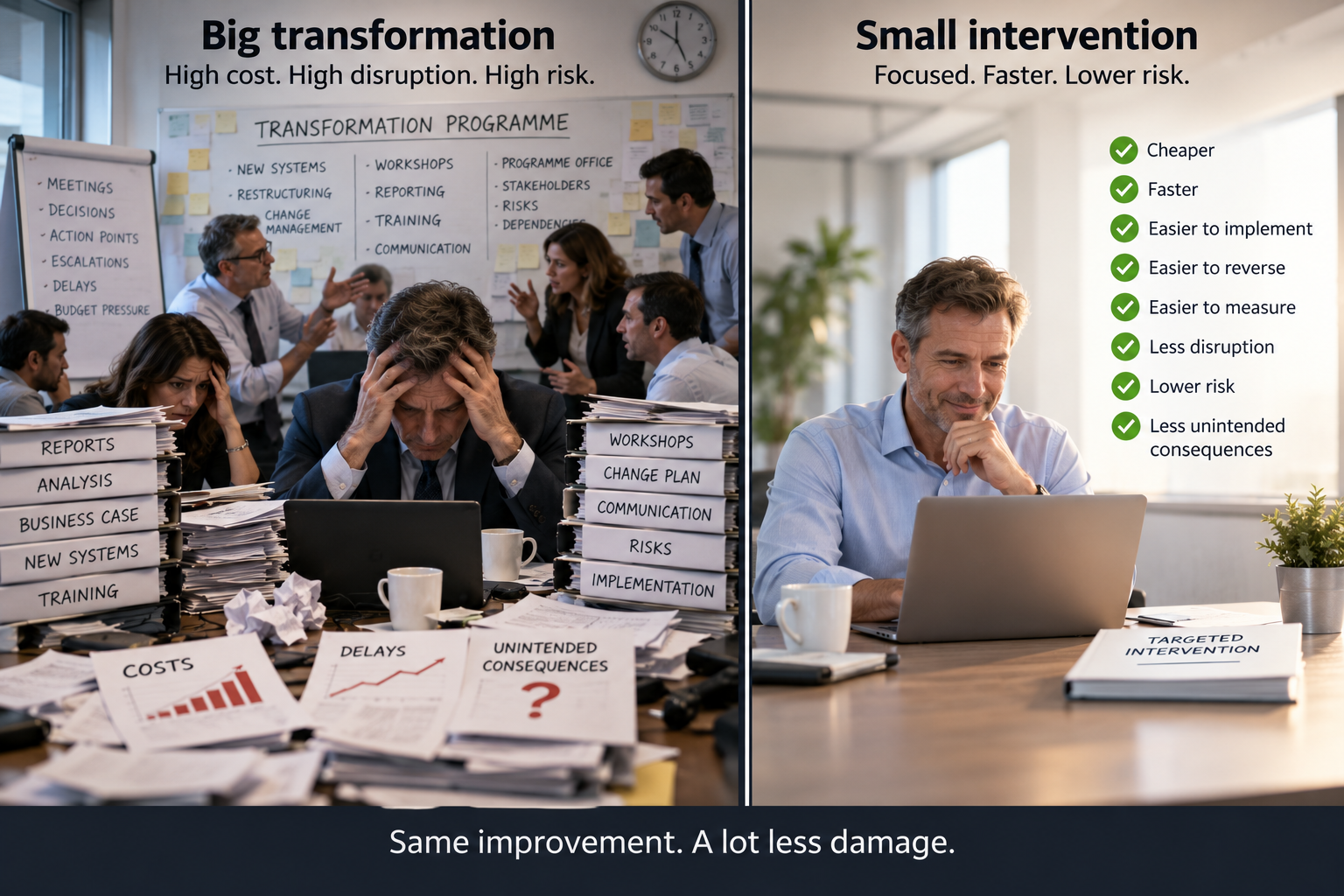
Transformation isn’t free.
Even when the consultants’ invoice looks manageable, the organisation pays another price.
Management attention.
Meetings.
Workshops.
Programme offices.
New reporting.
New systems.
Training.
Restructuring.
Uncertainty.
Change fatigue.
And every major intervention carries risk.
You may fix one thing and break another.
That’s particularly dangerous in complex systems because cause and effect aren’t always obvious.
So if two interventions could create the same improvement, the smaller one has an enormous advantage.
It’s cheaper.
Faster.
Easier to implement.
Easier to reverse.
Easier to measure.
And less likely to create unintended consequences elsewhere.
Sometimes the best intervention is surprisingly small
A £10 million production line stops because a £10 sensor has failed.
The answer isn’t a factory transformation.
Replace the sensor.
A £100 million tender is complete but must physically reach the customer before the deadline.
At that moment, the system constraint may be somebody with a car.
Give them the package.
A leadership team appears fundamentally divided over strategy.
Detailed interviews reveal that they’re largely describing the same destination over different time horizons.
Don’t launch an alignment programme.
Make the shared position visible.
The intervention should be proportional to the cause, not the apparent scale of the symptoms.
That’s why Precision Diagnostics starts with diagnosis
At Mindsheet, we gather the different perspectives across the management team.
We combine them with the available operational, financial and market evidence.
Behind the scenes, we use systems thinking and technology to build a structured representation of the business.
We define what the system is trying to achieve.
We identify the symptoms.
We construct the causal relationships between them.
And we progressively narrow the problem until we can identify where intervention is most likely to change system performance.
The objective isn’t to tell you everything that could be better.
You probably already know many of those things.
The objective is to answer a much harder question:
What is the smallest thing we can change that will make the biggest difference?
What’s the point?
A sophisticated diagnosis
Contact Mindsheet to find out more